
Certificate vs Certification: The Standard That Makes the Difference
We’ve all been there. You attend a training, sit through a few presentations, maybe complete a short test at the end you’re handed a certificate. It feels good to have something tangible in your hands.
But here’s the catch: not all certificates actually prove you can do the job.
That’s where certification — and more importantly, ISO 17024-accredited certification comes in.
And in industries where a coating failure on a pipeline, ship, or bridge can cost millions and put safety at risk, the difference between a certificate and a certification isn’t just academic. It’s critical.
Certificate vs Certification: Let’s Clear This Up
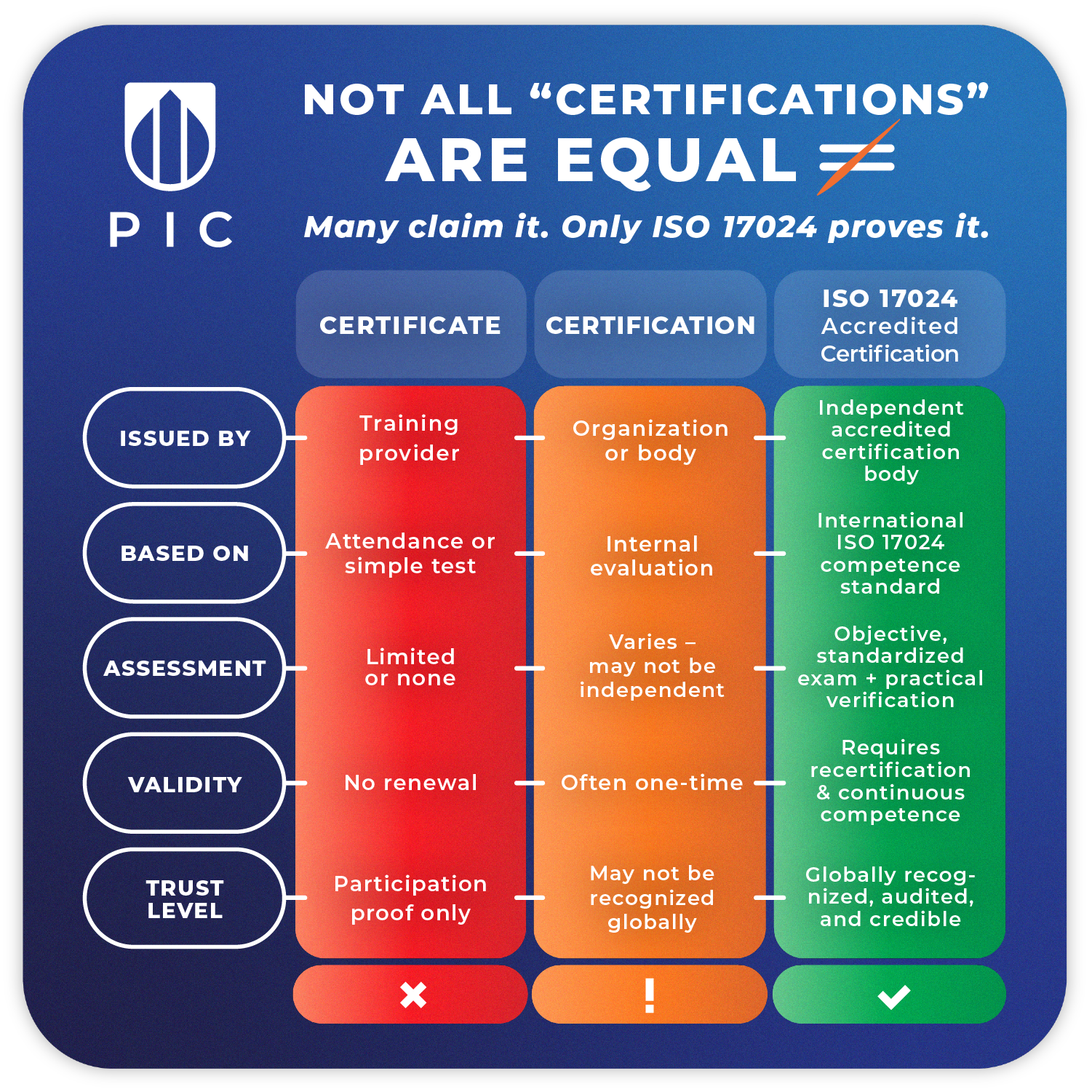
- Certificate: You participated. You attended a course, completed the requirements, maybe passed a test at the end. It shows you were there.
- Certification: You proved your competence. An independent body assessed your knowledge and skills against an international standard. It shows you can do the job.
With ISO 17024 it goes one step further: it ensures that the certification process itself is impartial, fair, and globally recognized. That means when someone holds this certification, their skills are trusted — not just by one company, not just in one country, but anywhere.
What Is ISO 17024?
ISO 17024 is the international standard that sets the rules for organizations that certify people. Its purpose is to make sure that when someone says they are certified, the process behind that claim is reliable, consistent, and trustworthy. To put it simply, ISO 17024 is the quality standard for certifying people.
At its core, the standard is built on a few key principles. First, certification has to be impartial — no bias, no conflicts of interest, just a fair assessment of someone’s skills. Fairness is key too: everyone should have the same shot at success. Then comes validity and reliability — in other words, the exam needs to measure the right things and deliver consistent results no matter where or when it’s taken. And finally, competence isn’t a “once and done” deal, which is why recertification is built in, to make sure professionals stay up to date as industries and technologies evolve. It may sound like formalities, but these are the things that make a certification credible and meaningful, instead of just another piece of paper.
Beyond the Paper: The Process Behind Certification
Plenty of organizations run training courses and hand out certificates at the end. That has value — but it’s not the same as certification under ISO 17024. The difference is that ISO 17024 sets the rules for certification bodies, ensuring their entire process is credible, transparent, and impartial.
So while a training body can teach skills and issue a course certificate, an ISO 17024-accredited certification body must go further:
- define clear requirements for who can be certified,
- design fair and valid assessments that actually test competence,
- separate the training from the decision to certify (so the trainers aren’t also the judges),
- and make sure competence is re-verified through recertification.
Many training providers claim to follow these principles, but without ISO 17024 accreditation there’s no guarantee. The standard is what turns good intentions into a proven system.
And that’s what gives international weight to the certification. It ensures that being “certified” means more than just attending a course — it means your skills have been tested and recognized according to a global benchmark.
Why It’s Especially Relevant in Our Industry
When it comes to corrosion protection and coatings, the stakes are simply too high to leave competence to chance. A single failure can mean millions in repair costs, lost productivity, and even safety hazards. And the challenges don’t stop there:
- Complex systems: Today’s coating solutions demand in-depth knowledge of surface preparation, application methods, and quality control.
- Global projects: With international supply chains, teams need one common “language of competence.”
- Rising regulations: Environmental and safety rules are only getting tougher.
- Skills gap: As experienced professionals retire, younger workers must quickly prove their abilities.
ISO 17024 certification directly addresses these challenges. By making competence measurable, comparable, and reliable, it ensures that the people trusted with these high-value assets are genuinely up to the task.
Why Should Anyone Care?
|
At the end of the day, certification under ISO 17024 isn’t just a technical requirement — it’s something that benefits everyone involved. Professionals, employers, clients, and even the industry as a whole all gain from having a clear, internationally recognized way of proving competence. For professionals, certification can be a career game-changer. It adds real weight to a CV, showing not only that someone has been trained, but that they’ve been tested and proven competent. It builds trust and opens up new opportunities across borders, since international recognition makes mobility much easier. Employers benefit just as much. Hiring always carries risk, but that risk is reduced when staff come with competence independently verified. It also broadens the available talent pool — you’re no longer limited to one country or region, because skills are measured against the same global benchmark. On top of that, companies save money in the long run, because less time and resources go into retraining when certified staff already meet the required standards. If you were managing a major infrastructure project across three countries, wouldn’t you want to know your team’s skills were assessed by the same standard? |
 |
Clients and asset owners also stand to gain. Certification helps ensure that assets are maintained properly and last longer, saving money by avoiding costly failures and repairs. It also means safer operations and easier compliance with the increasingly strict regulations many industries face. It’s about protecting investments — not only in infrastructure and equipment, but in people.
And finally, there’s the bigger picture: the industry as a whole. Certification helps raise standards globally, lifting the profession’s reputation and credibility with regulators, clients, and the public. It supports the future of the industry by creating a consistent framework for competence at a time when many experienced professionals are retiring and younger generations are stepping in. By setting the bar internationally, ISO 17024 helps ensure the next wave of professionals is ready to take on the challenges ahead.